Tuesday, 30 July 2019

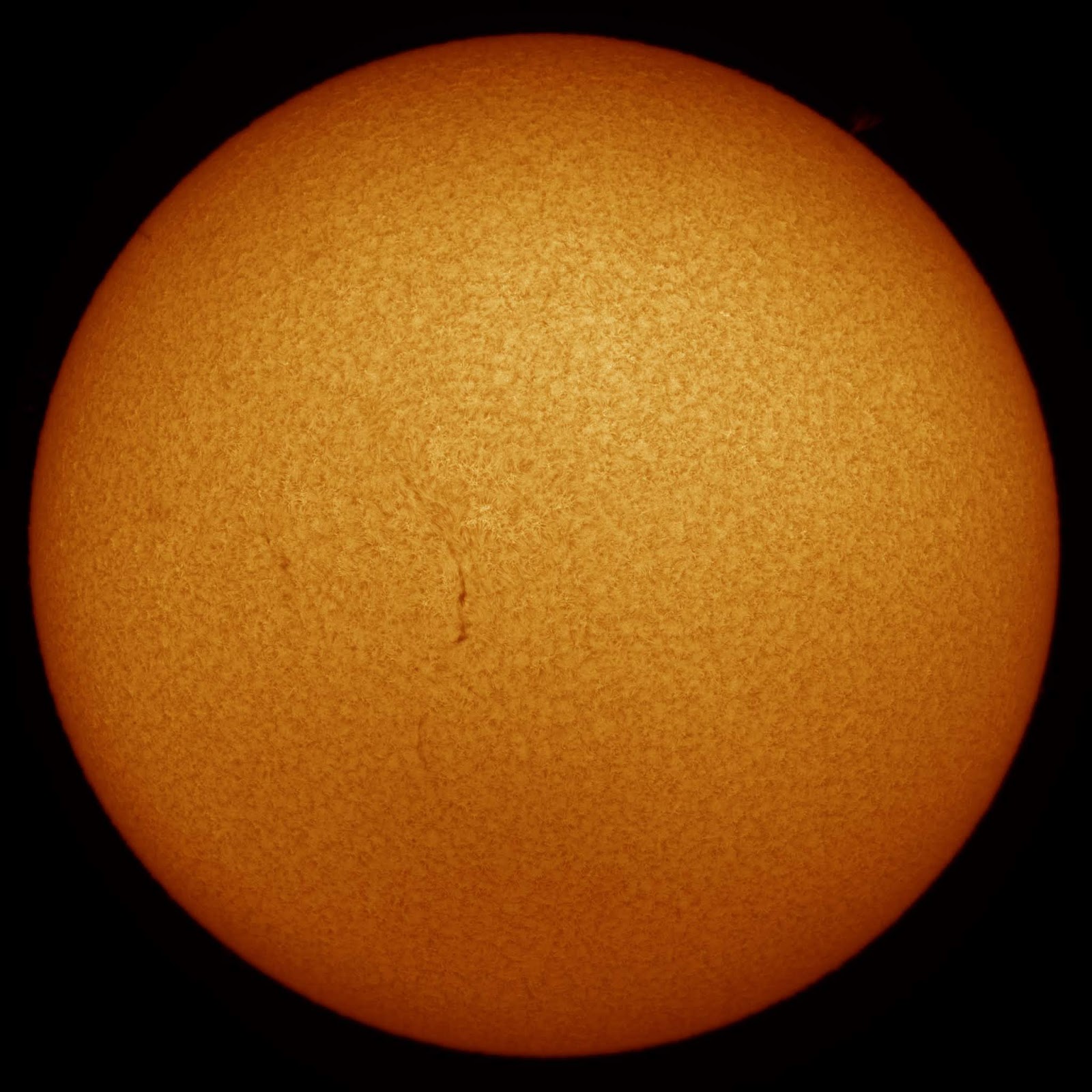
Filaments Mid Disk - 29th July


I took these shots of the filaments that are currently sat mid disk on the sun, these mark the position of the boundaries of coronal holes, that, also in turn mark the position of the boundaries of the magnetic fields associated with a region of the sun that spawned active region way back in the spring time.  This has survived several solar rotations now, with each rotation manifesting itself in slightly different form as it becomes weaker.  There is every chance that this region is the last major event of cycle 24 and so represents the 'terminator' event for this cycle.  While the magnetic field strength has dropped below the 1500 gauss needed to produce sunspots, there is sufficient magnetic fields to still produce filalments and also coronal holes.  It may well be that when the features we see above have finally totally (magnetically) diminished that this is when cycle 25 starts to kick in proper.  This may well have a few more rotations of activity left in it before it is gone, but will be interesting to track and hopefully observation backs up the theory.  The top image was taken with the 8" HaT and Daystar Quark with the 0.7x Baader Solar Telecompressor and the FLIR GH3 IMX174 camera, bottom image shows wider scale with the SM90 double stacked with the Daystar Quark and the FLIR GH3 ICX916M camera.  

Monday, 29 July 2019

Ha Full Disks 29th July


A couple of full disks from today; first up with the Coronado SM90 at prime focus, then followed by the double stack disk with the Lunt LS50 etalon and Daystar Quark.  Camera used in both instances was the FLIR GH3 ICX916M.  There isn't a huge amount of difference in details that would normally be expected in a single stack double stack comparison.  Maybe I didn't have the etalons tuned quite right?

Friday, 26 July 2019

Remnants of Active Regions in Ha - 25th July

This filament and turbulent plage is all that now remains of the equatorial active regions that marked the last major activity of cycle 24.  Taken with the Coronado SM90, 2x cemax barlow and the FLIR GH3 IMX174 camera.

Thursday, 25 July 2019

Departing Active Regions in Ha - 25th July

This is the only 'hi res' shot I salvaged today, with the SM90 and 2x cemax barlow, with temperatures up in the high 30's imaging wasn't really on the cards!  A few days ago this turbulent plage on the limb was a small cycle 24 active region.  The IMX174 camera was unhappy as was recording a working temperature of 62c - ouch!

Ha Full Disk 25th July

A hot day today, probably the hottest of the year. Seeing was shot before 7am and I seemed to waste too much time trying to get hi res stuff to no avail. The cameras weren't liking it and were up over 60c. In the end was too hot to be sitting directly in the sun so settled for a full disk. Lunt 50 etalon double stacked with the Quark on the ED60 f6 scope, Baader 0.7x solar telecompressor was used with the GH3 ICX916M to get a full disk on the chip.

The sun is far from quiet, despite what Spaceweather.com keeps saying - the filament coming around the limb on the equator marks where we had active regions around Easter time, a small flux region mid disk is also the decaying relics of cycle 24. The active region from earlier in the week has all but decayed before it passes over the limb in the next day or so. No proms today but a few bright points here and there that may be indicative of cycle 25, the northern filament is likely to be indicative of the cycle 25 band.

Tuesday, 23 July 2019

AR12745 with the HaT 23rd July

Conditions were good before 7am this morning, and before the seeing completely deteriorated  I got this image of the active region with the Airylab Hat, Daystar Quark and FLIR GH3 IMX174 camera.  The active region has considerably died back in activity compared to yesterday, and by wednesday I expect little to be left apart from a patch of plage.

Ha Full Disk 23rd July

Todays full disk is rather quieter than the previous; the active region has diminished in activity, and also the filament to the north has also faded away.  There are nice proms visble though!  Taken with the LC50 on the ED60/f6, double stacked with the Daystar Quark and also using the Baader solar telecompressor to reduce the image scale back a bit, camera was the FLIR GH3 ICX916M.  Looks like the plage relics of the active regions from previous rotations may be making a come back on the western limb, certainly something to keep an eye on in the days ahead...